My father is a former Marine, and his patriotism has never felt ornamental to me. It is tied to duty. It comes from a belief that if something has given you a home, a language, a life, a shelter, a set of obligations, then you owe it something back.
My mother’s American story is different, but no less real. She was born and raised in Israel, moved to America, fell in love with the United States, married my father, and became an American citizen. Her favorite holiday is Thanksgiving, which makes perfect sense to me. My Eema brings a phenomenal warmth to everything she does, and Thanksgiving is, at its best, a holiday of warmth: food, gratitude, welcome, family, abundance, the table as a form of belonging. Even after moving back to Israel with my father after all these years, she is still proud to be American. Her love of America is chosen, practiced, hosted, cooked, played on the piano, and brought into rooms.
I know something about layered belonging from another side too. I served as a combat medic in the Israeli military. I wore the uniform of one country while carrying the passport and love of another. I do not experience that as a contradiction to my American-ness, or to my patriotism. If anything, it has made the word duty feel less abstract. Countries are not loved only in theory. They are loved through what they ask of us, what we are willing to carry, and what we refuse to abandon when love becomes complicated.
That is the part of patriotism that is easily lost when people speak about love of country as if it must be either blind loyalty or moral embarrassment. There is a patriotism that refuses to see a country’s wounds. There is also a sophistication that can only see the wounds and calls that sight wisdom. Neither feels honest to me. Love of country, if it is going to mean anything, has to be more demanding than pride and more generous than contempt.
My grandmother was there too, my mother’s mother, born in France in 1935. At some point she remembered the French anthem, which she had not sung in so long. My mother went to the piano and began to play so my Savta could sing. It was one of those small family moments that is also not small at all: a woman born in France before the war, singing an anthem from a country that was once home, while her daughter, an Israeli-born American citizen, played beside her, in a house in Israel, under American and Israeli flags.
Eventually my grandfather came down too. He was born in Tel Aviv in 1926, Yemenite, from a family that made Aliyah to Israel through Egypt. He is related by marriage to Saadia Khobashi, the Yemenite representative who signed Israel’s Declaration of Independence. At some point, we ended up sitting together and researching his family origins, trying to understand where exactly they were from, what route they took, what names and places had carried us here.
History is not only something in books or museums. Sometimes history is my almost 100-year-old grandfather sitting at the table or walking slowly down the stairs. Sometimes it forgets, and then suddenly remembers when music begins. Then someone opens a book, or a screen, or a family story, and the past becomes a place we are still trying to locate.
Later, I found a book in my father’s library about the original colonies in America, including records from the colonizing of Virginia. We read a little from it before reading from the Tikkun he had given me. America, Israel, France, Yemen, Torah, colonies, flags, anthems, piano, family stories. What a melange. What an inheritance.
And still, I do not experience these origins as contradictions. I have three passports — American, French, and Israeli — and I am proud of each one. Not in the same way, not for the same reasons, not without pain or complexity. But I am proud. Each one carries a story of belonging, exile, refuge, responsibility, and return. Each one represents a different answer to the question of where I come from, and none of them cancels the others.
Simone Weil wrote that “to be rooted is perhaps the most important and least recognized need of the human soul.” Rootedness is not the same as purity. A tree with many roots is not less rooted. It may be stronger for having learned to draw life from more than one depth.
Maybe that is why living in America and hating America feels almost blasphemous to me. Not because America is innocent. It is not. No country is. America carries conquest, slavery, exclusion, hypocrisy, and failures that cannot be waved away with fireworks. But a country is not loved by pretending it is simple. It is loved, if it is loved ethically, by telling the truth about what it has been and still refusing to despise what made your life possible. This is an ethical question as much as a patriotic one: what do we owe the places that formed us, especially when we can see their failures clearly?
That is a difficult thing to say now. We live in a time when critique often masquerades as courage and gratitude can be mistaken for ignorance. But gratitude is not ignorance. It does not forbid criticism. It gives criticism a home inside responsibility. Without gratitude, criticism can become contempt. Without criticism, gratitude can become denial.
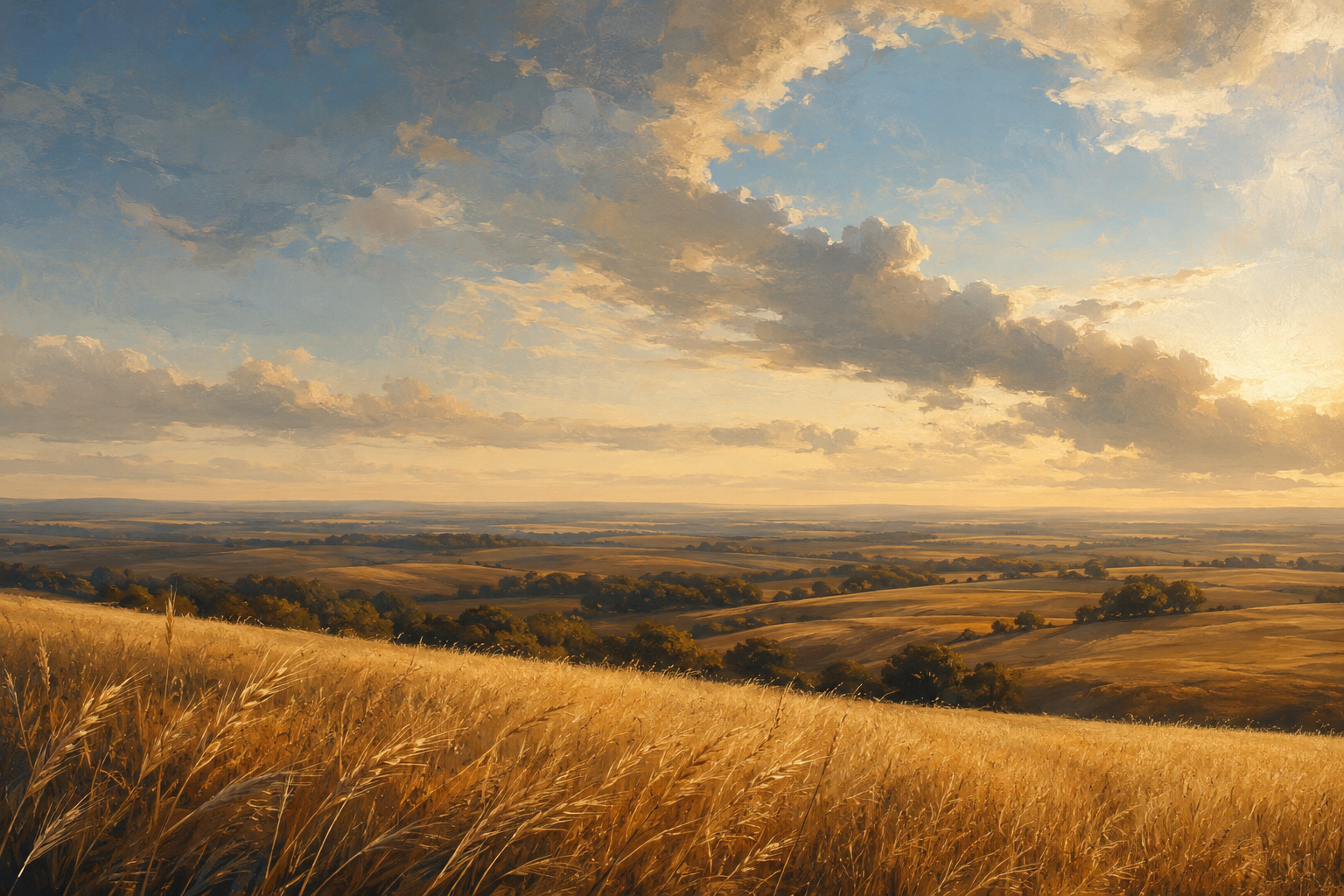
Maybe that is why the old American songs still move me. “America the Beautiful” does not begin with victory. It begins with sight: spacious skies, amber waves of grain, purple mountain majesties above the fruited plain. It asks us to look before we judge, to receive the beauty of a place before reducing it to its failures. And then, almost immediately, it becomes a prayer: “God mend thine every flaw.” Love does not require pretending the flaws are not there. It asks God, and asks us, to mend them.
There is also, I admit, the romance of America. The cowboy America. The wide-open-land America. That irresistible Clint Eastwood movie hypnotism of it all: the sound of spurs, dust rising under a hard sun, a hat tipped low, a “Thank ya, ma’am” with a twang. I know myth is not the same as history, and the West was not innocent. But myth still tells us something about what a people longs to be. The American cowboy, at his best, is restraint, solitude, grit, manners, danger, and a code. He carries the fantasy that a person can meet a vast and difficult world with courage, competence, and a few words spoken plainly.
“My Country, ‘Tis of Thee” gives another language for this: “let freedom ring.” Not let freedom be declared once and then treated as finished. Let it ring. Let it keep sounding from mountainsides, across generations, through argument and repair. Freedom is not only an inheritance. It is a practice made audible by people who understand that gratitude and responsibility belong together.
This is what I think patriotism can be at its best: not worship of a state, and not performance of belonging, but a willingness to enter the story honestly. It can thank what deserves gratitude, grieve what deserves grief, and still refuse the luxury of hatred when hatred becomes a way of avoiding responsibility.
The past brought us here. That does not mean the past was always good. It means it was consequential. Painful things we would never choose to relive may still become the places from which growth, duty, and moral imagination emerge. My family’s story is full of displacements and flags, anthems and migrations, wars and prayers, countries loved imperfectly and carried forward anyway. I do not want a patriotism that erases any of that. I want one large enough to hold it.
Maybe that is what I felt yesterday: not balance between past and future, but continuity. A French-born grandmother singing beside an Israeli piano. My Israeli-born mother playing for her while carrying a love of America all her own. A Yemenite grandfather born in Tel Aviv sitting in the same house. American and Israeli flags outside, the Beach Boys inside, colonial records on one side of the table and a Tikkun on the other. I stood there as an American, French, and Israeli citizen who had served in the IDF, and none of it fit neatly. All of it belonged.
God bless America. Not because America has always been good, but because blessing is not a denial of brokenness. It is a hope, a demand, a prayer over what still might become worthy of itself. God bless the mountains and the prairies and the majesty. God bless the people who came through pain and still built homes. God bless the countries that formed us, the duties they gave us, and the courage to love them without lying.
And God bless the strange inheritance of being made from more than one place. It may be one of the reasons we can learn to love any place at all.
Avi Finley writes at the Modern Ethicist on ethics, relationships, communication, law, and the moral questions that show up in ordinary life.